Through my experience working with both independent grocery stores and large national chains, I’ve seen a consistent and recurring pattern when it comes to facility water filtration. It doesn’t matter whether the store is brand new or has been operating for decades. Water filtration is often treated as an afterthought rather than a critical infrastructure system.
Facility managers, whether they are new to the role or highly experienced professionals, are tasked with juggling an overwhelming range of responsibilities. New builds, remodels, HVAC, plumbing, electrical systems, and vendor coordination all fall under their scope. Even the most seasoned facility managers are stretched thin across multiple locations and priorities. Because of this, there is a heavy reliance on service providers to not only perform the work, but to provide expertise, guidance, and recommendations that are truly in the best interest of the facility.
Unfortunately, that level of partnership is far less common than it should be.
Over the years, I’ve worked with many new customers who had been using the same service contractors for decades. When we began reviewing their water filtration programs, a few issues surfaced again and again. In some cases, contractors were maintaining the status quo by reacting to problems as they occurred rather than proactively addressing root causes. Reactive service is easier, more predictable, and often more profitable from a service provider standpoint, but it rarely reduces downtime, extends equipment life, or lowers long-term costs for grocery stores.
In other cases, we found cookie-cutter filtration systems installed across multiple pieces of equipment with completely different water quality requirements. Ice machines, beverage systems, produce misters, bakery proofers, coffee equipment, and combi ovens all have unique manufacturer specifications. Yet the same filtration was being applied everywhere simply because it was familiar or readily available. Little to no effort had been made to research equipment requirements or evaluate incoming water conditions.
That approach creates risk. It leads to scale buildup, inconsistent performance, voided warranties, poor product quality, and unnecessary service calls, all of which ultimately fall back on the facility manager.
At FillPure, we’ve taken a very different approach.
We’ve invested significant time and resources into expanding our expertise in water filtration across grocery environments. This includes ongoing research, attending water quality and treatment conventions, building strong relationships with manufacturers and suppliers across the industry, hiring and deploying in-house technicians in the markets we serve, and developing structured training programs to ensure consistent service standards.
Our goal is simple. Remove doubt for the facility manager.
The last thing a facility manager needs is to be questioned about a program they oversee, or worse, to discover after the fact that equipment under their responsibility was never properly protected or maintained to standard.
That’s why transparency is at the core of how we approach both new and existing programs.
For any new project, we always recommend a site survey, preferably conducted in person by a trained team member. During these surveys, we identify every point where water is supplied throughout the facility. We document equipment make and model information, review existing treatment methods, inspect current filtration installations, and perform on-site water testing.
From there, we research manufacturer requirements and work directly with the customer to establish minimum and recommended standards. Only after that process do we develop filtration and service recommendations.
The photos below were taken during a routine site survey. At the time, the facility manager was confident that the water filtration systems at this location were in good condition and being properly maintained. That confidence is understandable. On paper, the site had an active service provider, documented filter changes, and no major recent equipment failures. However, with a minimal amount of digging, it was clear that there were significant issues with the filtration program, including improper system configuration and components that were no longer providing effective protection.

This system was located in the basement of the site and was supplying multiple points of use throughout the facility. The equipment showed clear signs of long-term neglect, which had resulted in ongoing leaks. Over time, those leaks contributed to moisture buildup and visible biological growth around the system.
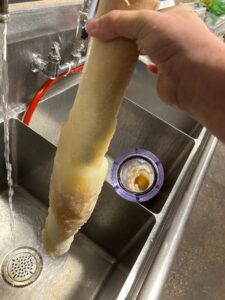
Resin had discharged into the line following a water softener failure. The system was placed in bypass by store staff due to low pressure, and because the site was not receiving annual preventive maintenance, they were unknowingly operating on untreated municipal water. Since this supply was feeding sensitive espresso equipment, this resulted in significant scale buildup within the downstream equipment.
This example highlights a broader challenge facility managers face every day. A facility manager cannot be in every store, nor can they personally oversee every service provider working across their locations. Even well-intentioned vendors can miss problems, take shortcuts, or continue servicing water filtration systems that are no longer appropriate for the equipment or water conditions. Without regular, knowledgeable oversight and verification, issues can go unnoticed for years, quietly putting equipment performance, warranties, and product quality at risk.
The result of a proper assessment is a customized service program that aligns with the facility’s equipment, water conditions, operational priorities, and budget, and one that the customer has full visibility into and control over. No guesswork. No one-size-fits-all solutions. Just informed decisions backed by data and experience.
In grocery facilities, water touches almost everything. Because of that, filtration should be treated as a managed program, not just a line item or a reactive service call.
For facility managers evaluating a new service provider, or reassessing an existing one, the right questions matter. Ask whether your provider performs site surveys or relies solely on assumptions. Ask how equipment specifications are documented and verified. Ask how water is tested, how often results are reviewed, and whether filtration recommendations are tied back to manufacturer requirements rather than convenience or familiarity.
It is also worth understanding how your provider trains their technicians, how consistent service is maintained across multiple locations, and how issues are identified before they turn into failures. A strong provider should be able to explain not only what they are servicing, but why a specific filtration approach was chosen for each piece of equipment.
Ultimately, a well-designed water filtration program should reduce risk, protect equipment, and give facility managers confidence when questions arise. When transparency, documentation, and proactive oversight are built into the process, filtration becomes one less variable a facility manager has to worry about.
By: Aaron Boyer, FillPure Director of New Business Development
Leave A Comment